
Broken Ankle Surgery in Delhi
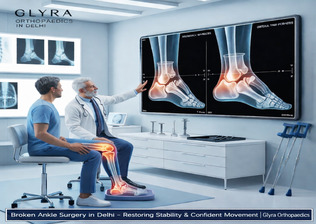
The ankle is essential for movement and stability. It supports your full weight and allows smooth actions like walking, standing, climbing stairs, and turning. So when the ankle breaks, routine life becomes difficult right away. Even short steps can hurt, and basic tasks like going to the bathroom or standing briefly may feel difficult.
At Glyra Orthopaedics, specialists provide step-by-step guidance from diagnosis to rehabilitation. In complicated cases, Broken Ankle Surgery is needed to restore stability and avoid long-term ankle problems.
Understanding Ankle Fractures
An ankle fracture happens when one or more bones of the ankle joint break. In some cases, the bone only cracks slightly, but in more serious cases it breaks fully and shifts out of place. Most patients develop swelling, bruising, tenderness, and difficulty putting weight on the ankle soon after injury. Many also feel unsteady, as if the ankle can’t support them properly.
Some fractures remain stable, while others disturb the ankle joint surface and affect the way the ankle functions. Accurate evaluation matters. At Glyra Orthopaedics, doctors combine clinical checks with imaging to determine if the ankle can heal in a cast or needs Broken Ankle Surgery.
Why Surgery May Be the Best Option
Casting works well for fractures where the bones remain aligned. However, surgery becomes important when the ankle is unstable or the bones do not line up properly. Broken Ankle Surgery is commonly recommended when:
- The ankle joint loses its normal structure.
- Bone fragments separate or rotate.
- The joint surface becomes uneven.
- The fracture impacts walking mechanics.
- Ligaments tear along with the bone.
Healing in the wrong position may cause ongoing pain and stiffness. Our team at Glyra Orthopaedics recommends Broken Ankle Surgery for stable, correct healing.
The Surgical Process Explained Simply
During Broken Ankle Surgery, surgeons realign the fractured bone pieces and fix them securely using plates and screws. These implants hold the bones in the correct position while healing occurs naturally.
This helps by:
- Maintaining ankle joint stability.
- Reducing the chance of re-displacement.
- Improving long-term walking ability.
- Protecting the joint surface from early damage.
- Allowing earlier controlled movement under guidance.
Each surgery is planned based on the fracture pattern, bone quality, and the patient’s daily lifestyle needs.
Rehabilitation and Healing
From the start after Broken Ankle Surgery, care focuses on swelling control, pain relief, and protecting the ankle during early healing. Weight-bearing is usually limited for a few weeks depending on the injury. Once the ankle is safe to move, physiotherapy starts.
Rehabilitation focuses on:
- Improving ankle flexibility and range of motion.
- Strengthening the foot, calf, and leg muscles.
- Restoring balance and stability.
- Training safe walking patterns.
Daily routines often resume within a few weeks to months, but sports and heavy work usually need more time.
Preventing Long-Term Problems
When an ankle fracture does not heal correctly, stiffness, swelling, gait imbalance, and early arthritis may develop. Broken Ankle Surgery reduces these risks by restoring joint alignment and stability. At Glyra Orthopaedics, regular follow-ups ensure safe healing and steady recovery.
Conclusion
A broken ankle may feel restrictive, but recovery is very possible with the right care. With timely evaluation, expert treatment, and physiotherapy, Broken Ankle Surgery helps patients regain stability and confidence. At Glyra Orthopaedics, healing is guided with comfort, safety, and active recovery in mind.
Had a great experience with us? We’d love to hear your thoughts! Click here to leave a Google review and share your feedback.